

How to improve safety in paragliding?
I have been flying for more than 40 years (since 1984!) and observing the behaviour of pilots on sites around the world.
For many years, I have contributed to the development of certification standards as a representative of the Japanese manufacturer FALHAWK. I have also designed and perfected some paragliding models.
I test all the paragliders that pass through my hands out of passion and to get to know them well in order to advise ASAGIRI SA clients before my retirement (end of 2025) and to write articles on my tests (activity that I continue!).
I perform collapses every time. I also test the manoeuvrability, the pitch stability at the output of 360… I know well the evolution of performance, safety and also ease.
Paragliding has evolved so well that I am shocked by the number of accidents that still occur. They are almost always caused by the pilot’s fault. I started a long reflection that led to this article.
In Switzerland, there are, on average, about 7 deaths per year while paragliding.
In 2024, with execrable weather for our activity and therefore very few flights performed, there were only 4 deaths.
In 2025, 17 people died while paragliding in Switzerland, most of them were ‘old pilots’.
What can be inferred? What can be done to improve safety?
I propose to review the different stages of a paragliding flight and the whole panoply of observations, decisions, and reactions that influence our safety.
Before takeoff
The important questions to ask yourself
Weather?
Is it a good day to go flying?
Weather apps aren’t always right!
It is necessary to prioritise real observation on the spot and caution.
The enemies are:
Strong wind
- When the wind is strong, takeoff can be difficult if one is not used to it. The ‘cobra’ technique is highly recommended.
- Rotors are created behind all obstacles.
- We don’t go where we want easily and if, by misfortune, we make a ‘return to the slope’, the wind speed is added to the flight speed, which causes significant damage.
Thunderstorms
When the weather forecast predicts thunderstorms, one must be careful and carefully observe the evolution, which can be rapid. Storms ‘in the afternoon’ can occur at 4 PM as well as at 1:30 PM!
Suivant la configuration du site de vol, des orages peuvent très bien se préparer à l’abri de votre regard, dans la vallée d’à côté…
Foehn wind
By definition, the foehn is unpredictable. It is therefore pointless to spend 2 hours observing its evolution!
For my part, when foehn is announced, I completely give up flying, because I don’t want to play Russian roulette!
The pilots who are already in the air
It’s not because there are pilots in the air that it’s good to go fly. They may bitterly regret having taken off…
This still gives information about the conditions, but it is not very reliable, because most often, we only want to see confirmation of what we already think!
Physical condition?
Am I in shape? Not too much stress?
Am I sufficiently hydrated? I always carry at least a half-litre bottle of water. A soft gourd or a plastic bottle!
ATTENTION
Metal flasks are dangerous: stored in the back pocket of the harness, they have already caused serious injuries during poorly controlled landings!
The choice of the takeoff site
The important questions to ask yourself
Est-ce qu’avec la force et la direction du vent, la distance d’envol est suffisante pour interrompre l’envol en cas de problème ?
Quand le vent n’est pas idéal, la course d’envol est bien plus longue… et on risque de vouloir s’élancer même si la voile ne nous porte pas bien !
When it’s not too good, it’s better
Takeoff
Problem
Few pilots take off serene. The vast majority are nervous, with jerky gestures that do not help at all to take off safely.
Often the pilots make a big ‘WOW!’ when they have taken off!
Purpose
Avoid nervousness and haste at takeoff by ensuring that the equipment is in order.
Have a calm mind to fully enjoy the flight and to be able to exploit a first lift from the first few seconds.
For this, a gesture adapted to current paragliders is needed!
Indeed, it wasn’t the same, 20 or even 10 years ago! The pilots who learned to fly a long time ago did not have paragliders at all identical to those of today.
These are better in everything (safety, ease and performance), but you have to adapt your way of taking off (and also flying, see below).
Solutions
Prepare yourself separately because the gaze of others makes you nervous. This way, you avoid disturbing others. When everything is ready, you move to the takeoff area.
Perform paraglider’s control inflations and pilot conditioning
It is the only solution to properly check the paraglider and avoid knots or branches in the lines. This also allows testing the wind strength.
Doing several check-ups is also very important to calm down, to “get in the mood”, forget worries and gain confidence.
Being in symbiosis with your paraglider and nature is vital for the important phase of takeoff.
IMPORTANT
Correct the canopy with ample movements.
It is absolutely useless to make small nervous gestures!
Knowing how to do a take-off facing canopy is a plus, but if you are not comfortable with this technique, you can take off in a classic way, but after doing some check inflation!
The timing in 3 phases!
The different phases of preparation for flight are not done at the same speed with today’s paragliders.
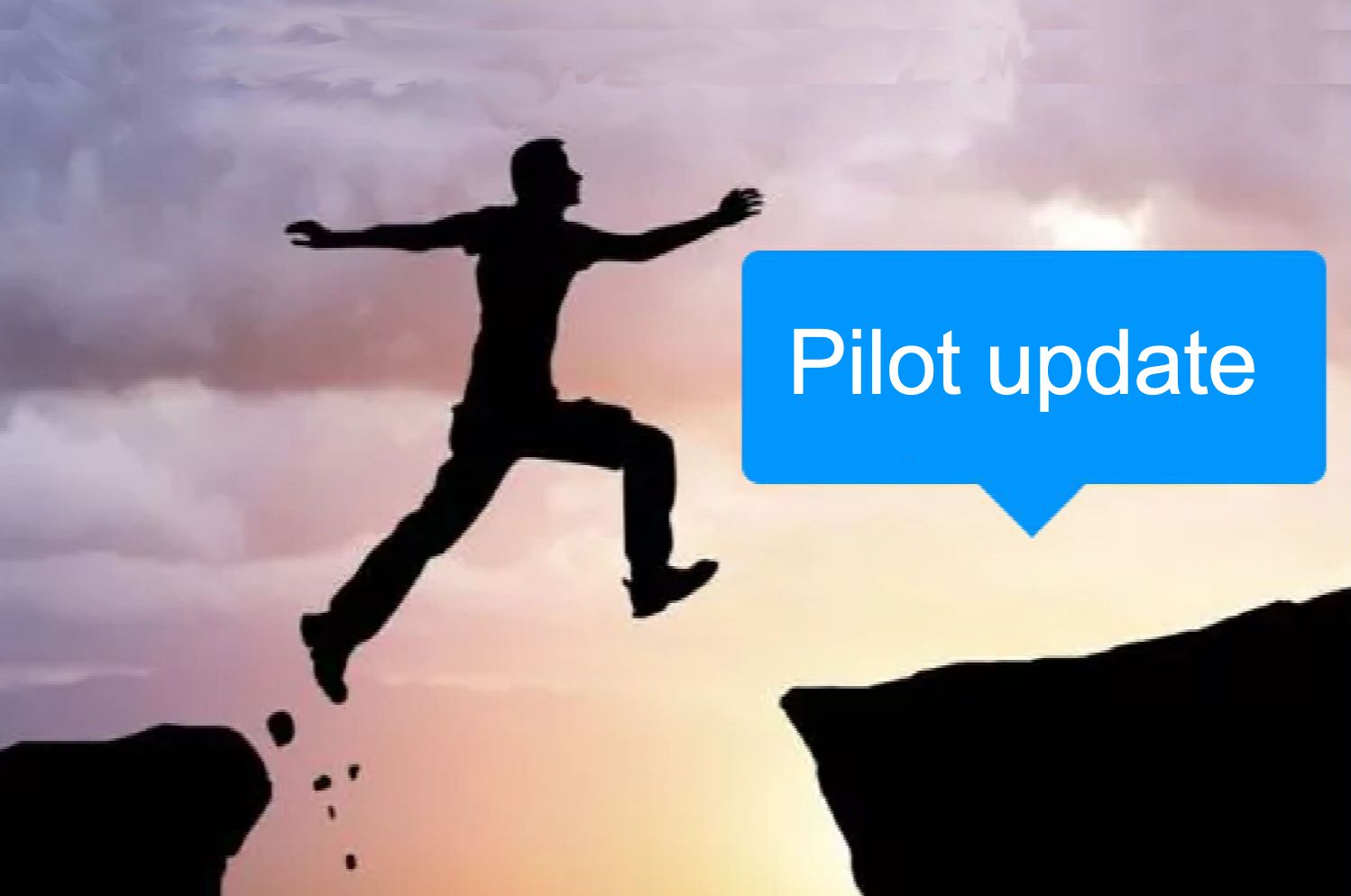
A real ‘update’ is essential!
It really serves no purpose to do things too quickly, especially if the paraglider is a light version. The time line is:
- slowly inflate.
- stabilize and observe the surroundings.
- make a sprint by loading the canopy (leaning forward a little)!
Far too many pilots do everything at the same speed, which lengthens the takeoff path and weakens the paraglider that is not well loaded when leaving the ground.
Do not hesitate to take a course with professionals to improve this essential step in our sport!
In flight
Problem
The feeling of insecurity in flight is common. We find that it’s turbulent and strange… We are worried, nervous… and this promotes inappropriate reactions, especially if one learned paragliding a long time ago, without having done a real “update” since!
Purpose
Enjoy the conditions of the day with a calm mind, without stress.
To be comfortable, you need to be well settled! And know the right behaviours to adopt in case of collapse that are an integral part of the activity!
Solutions
1 | Harness adjustment
Often pilots are poorly installed in their harnesses. In schools, we ensure that the buckles are well closed, but it’s not enough at all!
The adjustment of the belly strap is important. It is controlled during the certification of the paraglider, as it influences all behaviours and manoeuvrability. Too wide a setting does not improve handling. This was the case a long time ago. With recent paragliders, it’s even the opposite!
Do not adopt a position too prone.
It does not promote piloting efficiency and self-confidence.
2 | Do not tighten the brakes a bit
Do not make your paraglider unstable in pitch by constantly pulling a little on the brakes!
“Tightening the brakes to feel the canopy” is an obsolete formula that is still far too common.
You have to brake at more than 10% or be arm high, without breaking at all.
Tightening the brakes a little (less than 10%) makes the canopy unstable in pitch, which causes easier collapses!
This cancels the reflex effect of the pretty profiles of today’s magnificent paragliders. The reflex effect makes the paraglider “bite” into turbulence and thermals without making it “dive”.
The real reason for “tightening the brakes to feel the canopy ” has never been to avoid collapses, but to know immediately when one is experiencing one!
When one no longer felt weight in a brake, it was that the sail was closed on this side and that it was necessary to counter as quickly as possible with the other brake to prevent the sail from starting into ‘self-rotation’. A long time ago, in the absence of the pilot’s reaction, a closed paraglider began a spiral that could be fatal. This is no longer the case at all.
Now, with recent paragliders, it is even the opposite that happens most often. During a collapse, the pilot causes himself by his unnecessary action the stall on the open side!
It’s what we call the over-riding and really too stupid…
This concerns all recent models, maintained (rigging!) and approved EN-A, EN-B or EN-C (I’m even hesitating to include the EN-D), but not the competition paragliders CCC which are very delicate to the point that carrying two parachutes is highly recommended with these machines.
3 | Be comfortable with collapses!
Collapses are an integral part of the activity. Do not be afraid of them!
For a few years, this flight incident has been practised during training.
It is necessary to pilot actively to better exploit the ascendances, fly more efficiently and more comfortably + reduce the risk of collapse.
The best active piloting does not avoid all collapses,
so learn to no longer see fear and especially not to overfly!
Landing
Problem
We shouldn’t say ‘Phew’ when we land!
It is necessary to prepare well and adapt to the conditions.
Solutions
1 | Decide early enough
One must decide early on how to approach the landing.
If we realise that we will not reach the usual terrain,
it is necessary to choose an emergency landing field quite early.
The longer we wait, the fewer opportunities we will have!
2 | Wind direction
In the absence of windsocks or fumes, a GPS is very useful to indicate the wind direction with ground speed.
3 | Wind strength
It is necessary to adapt one’s approach to the strength of the wind. This means staying in the wind of the field if we consider that the wind can be strong.
Here is a landing technique for
- having more chance of making the target
- reduce the risks
4 | Be patient
It is important not to be in a hurry to land, whether for a top landing or to land in an official field.
You have to do S, go back and forth looking for calmer areas. The rush can make you arrive way too high above the landing zone!
And if you get too high, you will tend to want to brake more to still make the target… A stall a few meters from the ground, it’s a disaster,
5 | It’s not a big deal to be too long
Most of the time, if there are no buildings, highways or power lines,
it’s not a big deal to be too long and land in the field next door.
You will just have to compensate the farmer who owns the land. It’s much better than to stall a few metres above the ground and undergo months of rehabilitation for cracked vertebrae!
You will just have to compensate the farmer who owns the land instead of stalling a few metres above the ground and having to undergo months of rehabilitation for cracked vertebrae.
6 | Hit the brakes powerfully just before hitting the ground!
If the wind is not very strong (see next point) don’t be afraid to pull down a lot the brakes to stop the speed just before landing.
At 1 m ground, even if you stall your paraglider, it’s not a problem!
With small arms, it’s useful to do ‘a turn of the brake’ at the last moment to be able to brake more.
If you have too much speed when touching the ground, roll over or lift your legs to get on the protection! (Thank you, Jérôme Canaud, for the supplement.)
It’s not very elegant, but it can save your ankles!
7 | In strong winds, do not brake at all
Your ground speed is reduced by the wind. It is not necessary to reduce it even more while braking.
If you brake, you will be catapulted backwards.
When a wind of more than 25 km/h suddenly rushes into a paraglider of 20 to 30 m2, it moves!
You should rather turn around to lower the canopy with the rear risers and be careful not to get carried away by the wind.
Deflation ‘cobra’
A better technique is to lower the paraglider sideways, window-edge on a stabiliser as one does with a kite, in the minimum power zone.
For my part, it’s when I manage to catch a stabiliser that I feel safe.
Conclusion
Paragliding is a magnificent activity that mixes many fluctuating things.
Updates must be done often and quickly, including updates from the pilot himself, especially if he learned to paraglide long ago.
This can be done through reflections, questioning and also through advanced training courses with professionals.
I hope to have contributed with this article (and those linked) to improve your security.
Good flights!
Eric Laforge, March 29, 2026
Very good information. All very true.
Not many serene pilots on take-off. This is a very important point!
If not serene, you should not fly.
Maybe you need to make a film about this and not writing it !
Bruce Goldsmith
Concepteur d’ailes delta et de parapentes, champion du monde 2007, Bruce a travaillé pendant 20 ans pour AIRWAVE et quelques années pour ADVANCE. Il a fondé OZONE en 1999 et BGD en 2013. Bruce est également journaliste et écrivain.
General and personal opinion:
I agree on the points you address.
On my side, I am increasingly focusing on human, non-technical themes:
- how to renounce
- what prevents me from giving up
- in what mental state I am when I go to fly, take off, when I stay in the air
- what are my intentions and my objectives.
- what is my motivation, does it evolve over time
- on what I focus the attention on the different phases of a flight
- how I know that I am flying safely
- how I know that I had fun flying.
- debriefing
Ce sont ces thèmes qui me plaisent d’aborder en stage et, en plus de la technique, permettent au pilote de réfléchir sur sa pratique personnelle
Jérôme Canaud
WINGMASTER
eMasterclass Parapente, 100% online, 100% vidéo.
L’approche mentale est pour moi un facteur déterminant pour progresser en parapente, pour la sécurité et le plaisir de voler.
Jérôme Canaud
I absolutely validate everything you write…
Your article is based on all the phases of the flight and each phase is analysed with tips and tricks. How to do it?
For me, what would be missing is the human factor as usual. We no longer know what to say about the human factor. Yes, of course! There are plenty of errors in all phases of the flight, but most of the time, it is also due to the pilot, who should not have taken off and who still decided to go for 10,000 reasons.
And also, there are all these people who come out of school and who fly as best they can under an EN-A wing. And since that moment, they have been left to their own devices… They never do continuous training, maybe a poor SIV, once in their lives. So all their training is empirical and not worth much.
Greg Guhl
Greg works for the SHV (Swiss Federation of hang-gliding and paragliding). He is an aircraft and microlight instructor. He is also an importer in Switzerland of MAC PARA paragliders.
Others comments
Marion
Good article, I validate !!! 😇😇😇
Jean-Pierre
Beautiful exhaustive article on this vast subject 👍🏻
I love it and I love it 👏🏻
Should be part of the basic paragliding training manual 😎
Philippe V
Wow what a job and in truth it’s a pleasure monster to read your articles because with the disappearance of the regretted Parapente Mag, it is good to get back to basics and also to modify our “habits” of flight to adapt to new materials 😀
So above all continue to keep this sacred fire and to publish 🙏🙏🙏
As you rightly say, we have lost too many friends in our magnificent sport not to remain humble and with the honesty to respect the basics of this sport….
Congrats again 😀😀😃
Valérie
Very interesting and complete I find.
Kalina
Very good article well played💪🏻
Mario
Your article is very good, quite complete.
Of course, one can delve deeper into each chapter, but a book would need to be written for that.
One element has always seemed essential to me, it is that each pilot should succeed in knowing as much as possible the air mass in which he will evolve.
And this awareness encompasses first the general meteorological situation but also the place, the time of day and the period of the year.
Without neglecting the placement in relation to the terrain.
In short, knowing how to recognize situations where we will take risks based on our level of piloting and our experience. Not to mention the situations where he is unconscious of getting laid!
A comment from Honorin Hamard had pleased me, he wrote one day, after a flight, that he found the air mass so turbulent that he decided to go landing. It was in the middle of summer, a heatwave period… he wanted to warn about the risks of flying in these conditions surely due to global warming…
Philippe L
Beautiful article….
It’s true that nowadays, we tend to do things mechanically…..
We adapt to each new machine….
Beautiful thought👍