

Provoke yourself what you agree to undergo !
When flying by a paraglider, we need to be prepared for collapses. We have to prepare ourselves by provoking them to know what is really going on and to avoid the unnecessary or disproportionate reactions that are the main cause of accidents today.
With every paraglider I test, I can’t be comfortable until I can cause some collapses.
I advise all pilots to do the same, but only with paragliders
- EN-A and EN-B
- Recent models (certified less than 10 years ago)
- maintained (trimming).
A lot of paragliders don’t want to believe my statements about the collapses or the certification results for that matter (which say the same thing as me). So, it’s much better to live it yourself, to feel it with your whole body.
Do you remember Thomas the Apostle known as “doubting Thomas” ?
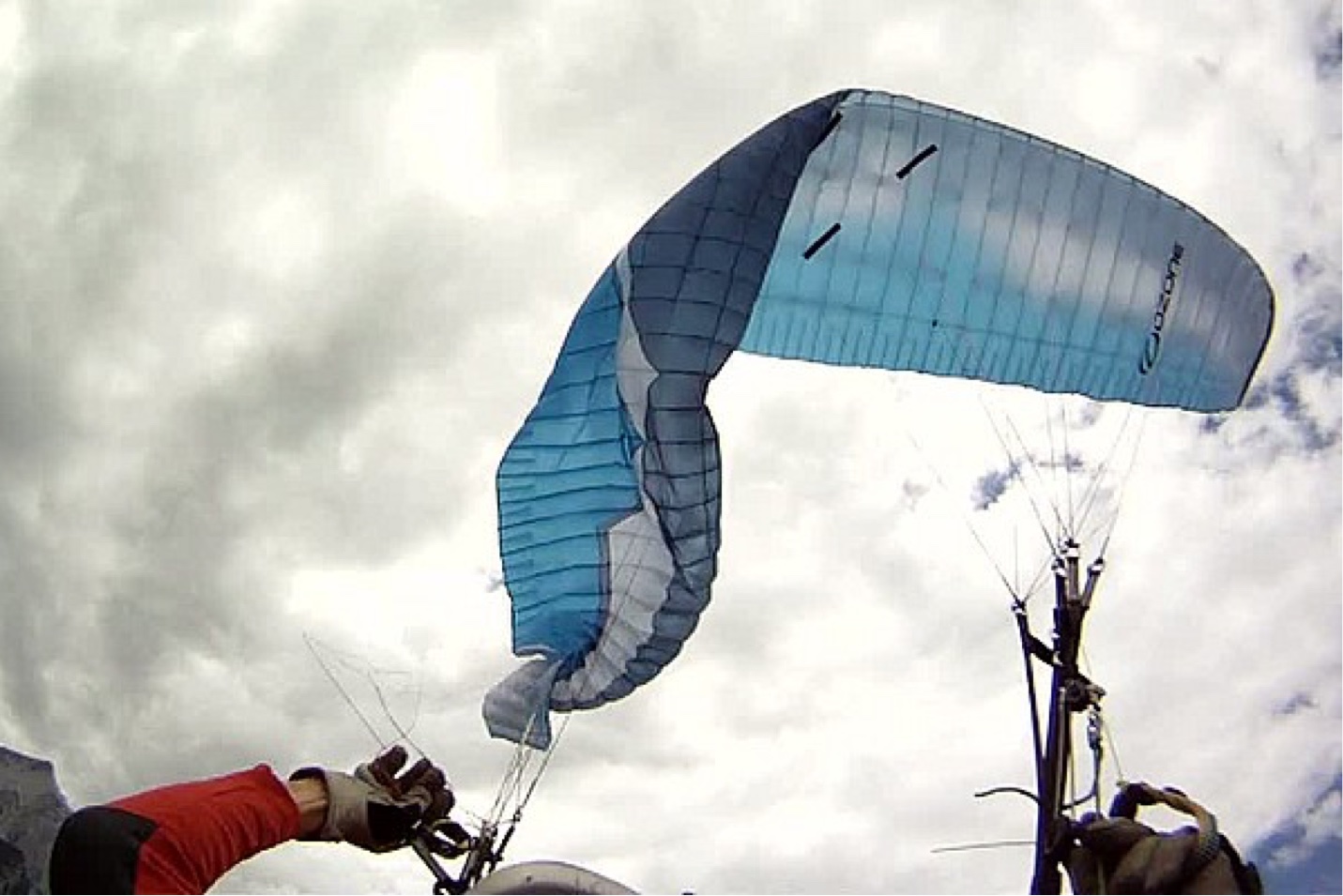
The asymmetrical collapses provoked
Crescendo!!! Small collapses to start with !
The goal is to understand and reassure oneself. Not to scare oneself!
New pilots have heard that you have to pull the whole A riser directly. I totally understand that, with a particular paraglider, a school might ask that of their students. But this is the only case.
Pulling the whole A riser straight is stupid and pointless !
Depending on the paraglider model, reactions can be very violent and random. We get a kind of half-frontal instead of an asymmetric collapse. The wing, closed in a way that has nothing to do with reality, can lean on the lines and cause violent reactions.
To be avoided absolutely except during a SIV (Flight Incident Simulation) course supervised by professionals, above the water and with a boat to recover you.
For my progressive tests of “induced collpases”, you can do them in calm conditions everywhere, but I advise having at least 10 m altitude! 🤣
Why in calm conditions? For you to experience the real behaviour of your paraglider.
Notice that turbulence tends to favour a quick reopening…
Procedure
Straight flight, arms high in the quietest possible air.
We don’t apply the brakes at all and we drop on the closed side, as test pilots do during certification flights.
Small easy collapse and already very interesting
I first cause a small collapse, which is already very interesting. It’s half of what any pilot can do and it’s called “doing the ears”. Most canopies even have specific risers to perform this standard “half-fast” descent manoeuvre (to be effective, it is better to accelerate at the same time).
So we make only one “ear” (we pull on the external lower line often alone on a dedicated riser) until we get the collapse.
WARNING
Not to be confused with the line of the stabiliser!
We see if it “snaps”, if it shakes the paraglider and if it reopens alone, gently or violently…
We also take this opportunity to quantify the change of direction. You probably think that the paraglider is going to turn on the closed side… well, sometimes it’s the opposite!
A little bigger… up to half the span
We then proceed in the same way by also grasping the 2nd external low line A, then, if necessary too, the 3rd line… up to 50% of the span with an angle of about 45 degrees.
If the desired collapse is not obtained, the lines can be pulled down or to the opposite side in a dry blow. This changes the size and angle of the collapse.
And we see what happens. In fact, these induced collapses verify the results obtained for this manoeuvre during certification flights.
Chances are you’ll get the same results as the certification:
- Little change of course
- Spontaneous full reopening in most cases.
With a session of induced collapse, you will be reassured and less prone to sudden, inappropriate and dangerous gestures when you have a “natural” one!
These sessions should be repeated to establish trust. They can be done at the end of the flight
- in calm conditions so that turbulence does not disturb behaviour.
- Not too low !!! The 10 m minimum mentioned above is obviously a joke ! But I did cause a collapse at 20 m ground…
Good flights and good collapses !
I’ve developed a lot of paragliding models and helped develop the certification standards.
For these activities and to get to know the paragliders we sell, I have caused thousands of collapses.
Eric Laforge
I must say that I find everything very calm today because it was infinitely “hot” at the beginning of paragliding!
Don’t forget to fly actively!
The results of collapse tests indicate the change in direction caused by a 50% (half span) and 75% collapse at a 45° angle.
These tests are done in calm air, which does not favour a quick reopening of the canopy.
The test pilot should not influence the result. He does not act at all on the controls and he lets himself go into the harness: it is quite penalising. Above all, it is reproducible so that the certification results are reliable.
Huge Progress & Light Fabric
All models of all brands have made huge improvements in behavior in recent years thanks to the evolution of sailing, profiles (Shark-nose), Nylon or Nitinol rods…
The flexibility of the Light fabric also helps calm when collapsed and also facilitates a gradual and rapid reopening of the canopy.
Lightweight fabric is now commonly used for some parts in standard versions.