

Fly more efficiently!
An ACTIVE pilot serves
- to make better use of thermals, to fly more efficiently and more comfortably.
- to avoid collpases, but not all!
With a modern paraglider, it is useless and dangerous to fly while slightly (less than 10%) applying the brakes “to feel the canopy”! See the video >> HERE
Bruce Goldsmith
Active piloting is PITCH CONTROL !
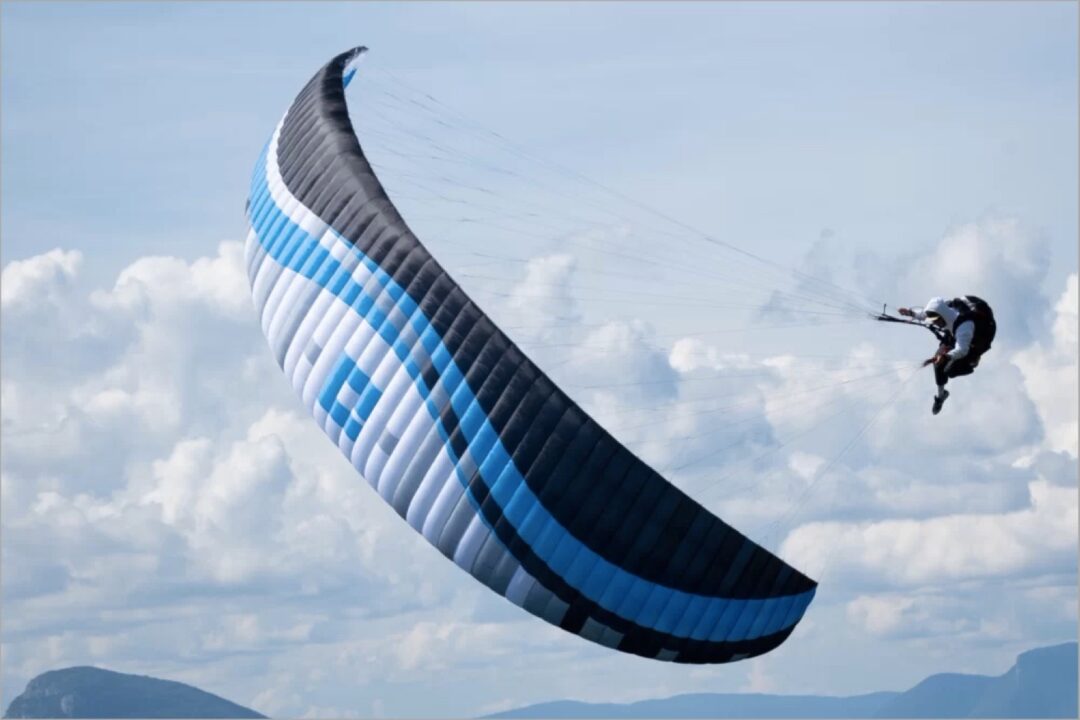
The goal is to keep the canopy above his head as much as possible.
The canopy DIVES
> Held it with a QUICK action on the brakes.
A dive causes airflow to tap on the top of the leading edge and this can cause a collapse as if pulling on the A lines.
Once the canopy came back over his head,
> The brakes are SLOWLY released.
The canopy goes BEHIND
>The brakes are SLOWLY released.
This “recoil” indicates that the paraglider is approaching a stall and it needs to be speeded up again. If you release too quickly, you risk a surge (see above!) and, thus, a cascade of incidents.
This “recoil” can be caused by an entry into a thermal. If this is the case (your vario beeps!), it is important to let the paraglider penetrate the lift before pulling the brakes. We can even use the speed bar!
You can even allow 2 to 4 seconds to get closer to the thermal core before deciding which side to turn. It will be on the side that lifts the most! See below.
Great asymmetry of actions
The brakes are pulled quickly to avoid a potentially imminent closure.
We always release the brakes slowly!
And above all, we return to the standard position, which is with hands up, without pulling the brakes at all!
 An old completely outdated advice!
“A little brake to feel the canopy” causes instability in pitching which is particularly dangerous near the terrain (cliffs, trees…) and the ground (landing) because it causes collapses.
Active piloting also means CONTROLLING ROLL ! !
Useful to better exploit thermals !
A wing tip LIFTS
> You load the harness on the lifting side and you turn on that side to take advantage of the lift.
 If necessary, with weak ascents, we zigzag to walk where “it goes up the most” hoping to find a “real” thermal that we can then wind.
Each meter of altitude gained brings us most often to better ascendances, so be patient and persevere!
Since we can’t avoid all collpases, learn!