

Not everyone has the same morphology, the same height, the same width at the waist (hips) and the same ratio between leg length and torso!
This makes it necessary to carefully choose the size of your harness and it obviously seems logical to try it on a professional before buying it (from the same professional, it’s better!).
A valid criterion for all the harnesses
The height of the lateral adjustments
They must be as high as possible without hurting under your arms when you are in flight position, so arms in the air.
If the settings bother you with your arms hanging out, it’s not a problem.
Back support is most often dependent only on lateral settings.
A criterion valid for all harnesses, except the POD harnesses
The length of the seat
It must be as long as possible without hurting under the knees.
For the POD harnesses, since the legs are resting on the footplate, the length of the seat is not a criterion at all!
Are we hesitating between two sizes?
You have to take the biggest one!
Provided that it does not hurt under the arms or inside the knees.
This will provide better support from the upper back.
The role of shoulder straps
Most often, the shoulder straps are connected below the carabiners. If that’s the case, when you squeeze them, you feel like a “sausage”, which can give you a reassuring feeling, but your upper back isn’t supported, you’re just squeezing it down!
The shoulder straps are there to prevent
- falling out of the harness if you’re upside down
- the harness from falling onto your ankles during takeoff
Note
There is no need to tighten the shoulder straps too much, as many people do, because these settings are very visible and easy to handle.
How to improve upper back support?
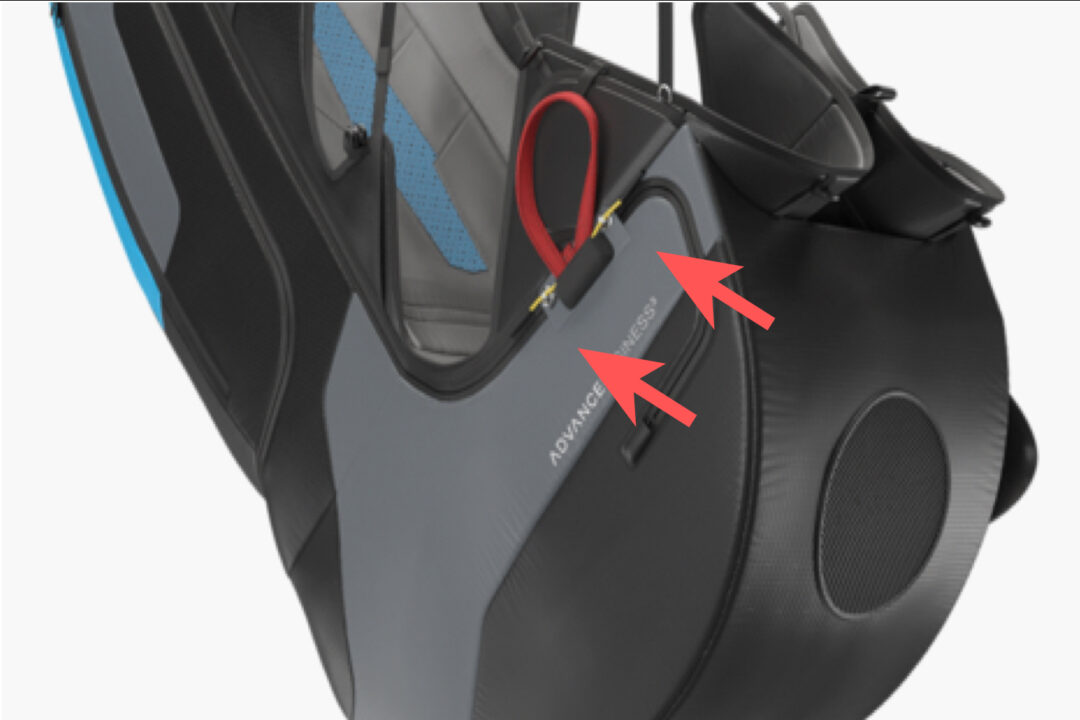
On some harnesses, which are pod harnesses only to my knowledge (NIVIUK ARROW P, ADVANCE WEIGHTLESS, OZONE F-RACE…), the shoulder straps are connected as high as possible on the carabiners, where they are held by parts made of Hypalon (synthetic material) or O-rings. (O-rings).
These adjustment straps are thus almost horizontal for maximum efficiency to support the upper back.
This also gives the advantage of being one with the paraglider in turbulence. The pilot is thus more stable, which saves him from having to stand at the risers when “it moves”!
Does your harness have poor upper back support? I developed a simple solution for any harness!
Seat width
Pod harnesses
The seat plates (when there is one) are always narrower than the seat on a cocoon harness. Their width does not influence the stability of the harness.
On the other hand, some models are not at all suitable for wide-hips pilots!
Classic harnesses, with seat plate
It is very important that the width of the plate is adapted to your body shape! It’s easy: see the article below.
Particular cases
 Pilots with excess weight
Some models are not suitable for overweight pilots because the ventral strap is too close to the body, which would force them to adopt a position that is too reclined, which I do not recommend.
 “String” and other light harnesses
In general, they cut small, because it reduces weight!
You will be much more comfortable in the size above your usual one!
 Tall pilots (185 cm and above)
In the technical data of the harnesses, you find the minimum and maximum size of the pilot. The positioning of the lateral adjustments is done so as not to interfere with the smallest pilot under the arms.
If you are over 185 cm, for good support of the upper back,
choose a harness model that includes an XL size!
It will be much more comfortable.
The adjustment of your position, for your comfort and efficiency!
It’s important to adjust your harness correctly.
This is especially tricky for a cocoon harness.
I can help you with that! The basic adjustments are described in the article below.
Ventral strap
The ventral strap of a harness must be adjusted to the value used for certification. This affects all the behaviours of your paraglider and your comfort.