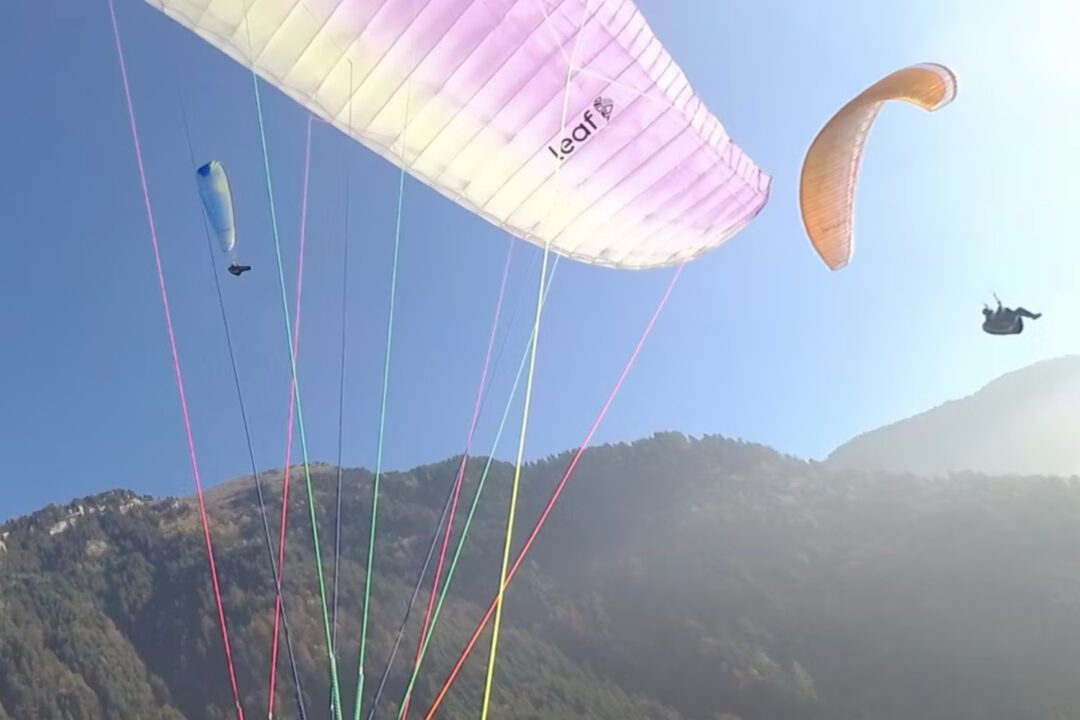


For a partial inspection and even for a small repair, a safety measure at the centre of the wing must be carried out in the area where the porosity is strongest, supplemented by at least 2 other measurements on different fabrics (position, weight and colour).
These measurements are carried out at the uppersurface, at a distance of 20 to 30% of the chord.
It is not desirable to work on a canopy that would no longer be suitable for flight!
This is the first test performed because if the fabric is too porous, the paraglider can no longer fly!
This porosity measurement is done systematically on every paraglider that passes through our hands!
A paraglider becomes porous when the coating of the fabric is altered mechanically by folding and tensions in the fabric and chemically mainly by moisture. Note that the coating is also there to stiffen the fabric especially in the bias and that a porous canopy deforms!
Fortunately, it is only when the porosity is really very high at the leading edge area (20 to 30% of the chord) that it can affect the behaviour in flight. But when this happens, it is very serious, because it makes the glider slower, the stall closer and even a likely stable parachute phase.