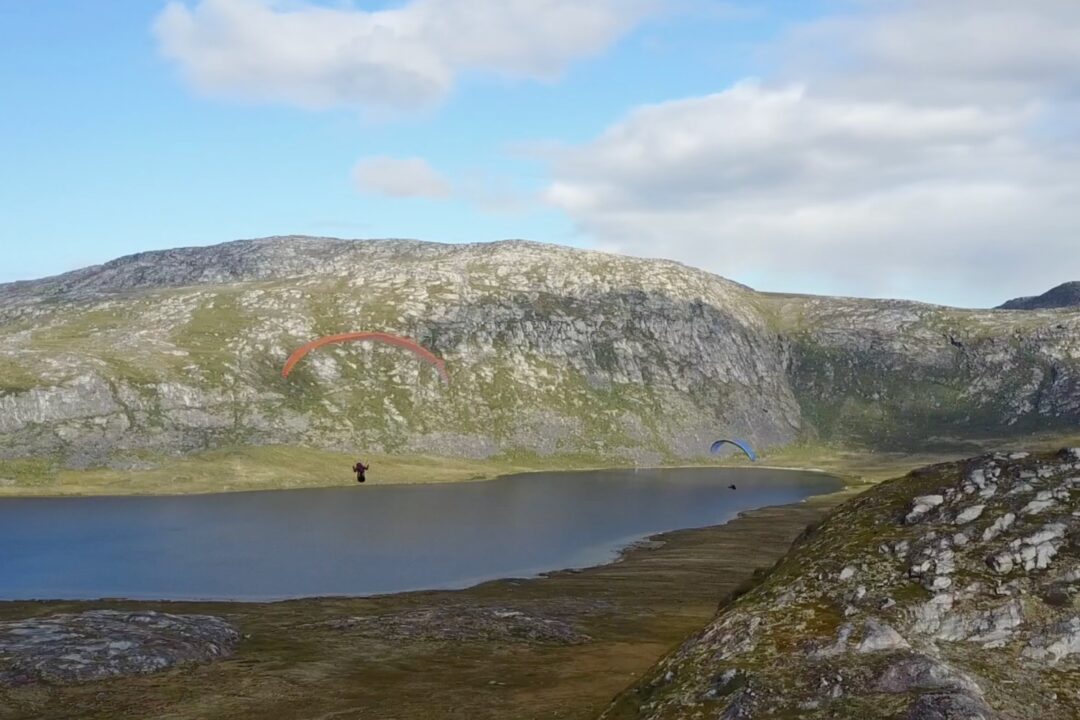


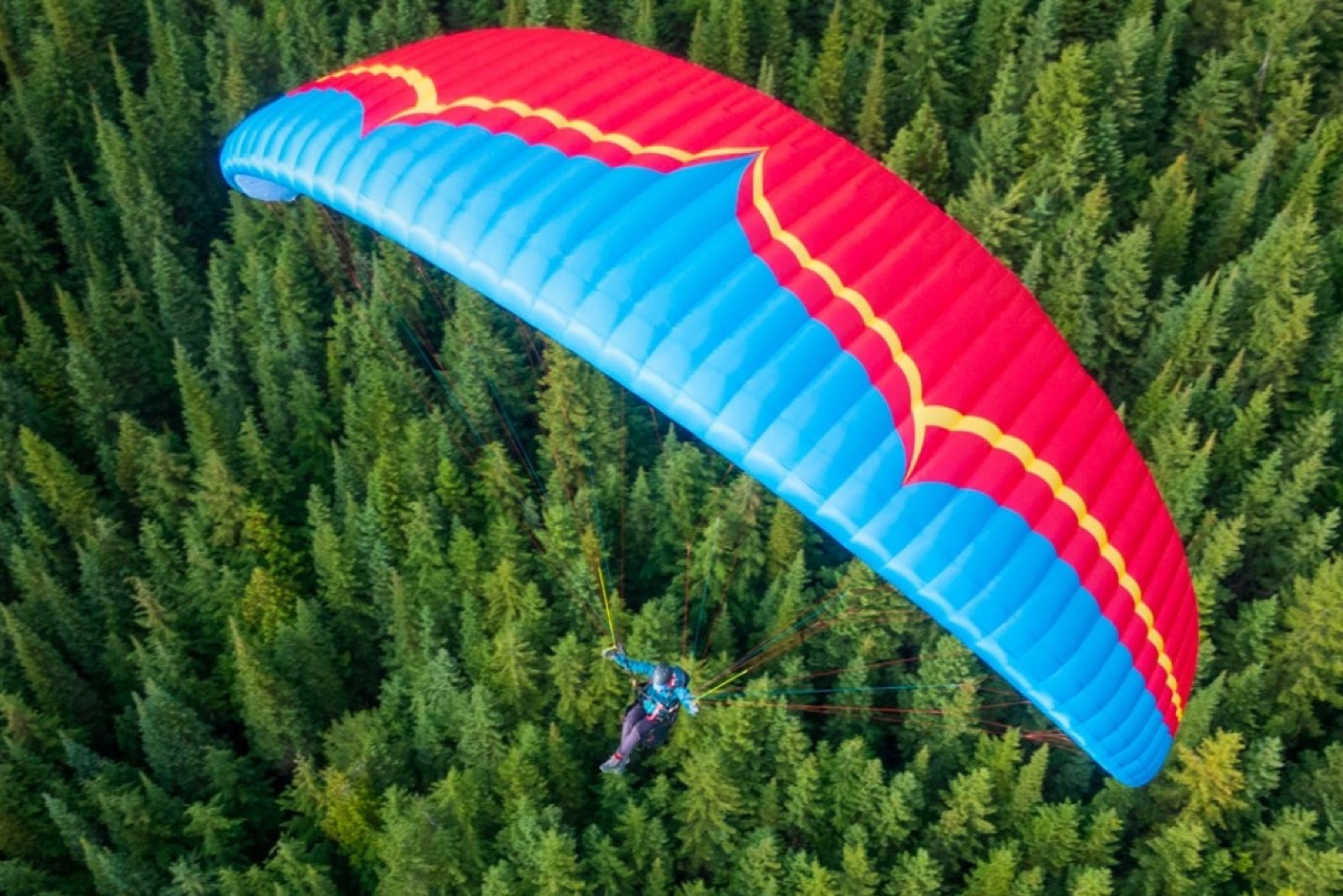
Eric Laforge PTV 89 kg, flight 6 June 2022 in Curnaux (Villars-sur-Ollon)
The weather is not very favourable (strong wind). By chance, a short less bad period allowed me to do this test!
Unpacking and discovery
The GEO 6 is made of a classic construction with very few rods, which makes it easier to pack. Small particularity: the G-Strings cords (the same as on the B+, RUSH 6) allow to keep the optimal shape of the openings in accelerated flight.
The materials are among the best currently available:
- LIROS PPSL (Dyneema sheathed in beautiful colours) and EDELRID 8000U (unsheathed Kevlar)
- PORCHER Skytex 27 g/m2 for the intrados fabric. This fabric can be easily repaired with adhesive fabric (Rip-Stop) and we can easily attach a registration number or a sponsor’s marking! This is not possible with all fabrics.
The extrados in SKYTEX and/or Dominico N20D.
The risers delivered, as standard, are made of 12 mm Polyester webbing.
OZONE mounts Softs-links (textile connectors) on its light models and this is therefore the case for the GEO 6. The lines are held in place on the Soft-links by O-rings. It’s really the hassle to handle when replacing a line or correcting the trimming!
Reminder: the weight difference maillons / Soft-links (textile connectors) is only about 70 g…
Note
We can replace the textile connectors with maillons!
The standard handles are comfortable. They are classically equipped with a snap to hang them on the risers. Only one regrets (the same with most light sails): these handles are devoid of swivels, but we add them easily!
The line system, sheathed for all low and intermediate lines, is simple and well differentiated by colour. Only the higher lines (connected to the canopy) are unsheathed. Disentangling is very easy.
Takeoff and flight
I am quite alone at takeoff and also in flight 😰
The conditions are strong at this midday. At first, it hits more than it goes up. It seems to be a standard lately on my fetish site…
After searching a little while losing altitude, finally, it climbs well. The GEO 6 docily goes exactly where I want. I don’t feel punished at all after my flights in B + and EN-C 2 lines!!! The big difference is that the GEO is economical in piloting actions. Its stability means that it requires few corrections in this turbulent aerology. The canopy is so calm that I started to daydream while rolling until suddenly being “awakened” by the sudden appearance of barbules!
I’m wandering around a bit, but the cloud base is low. I accelerate to full speed, with and without ears: it’s very easy and stable in both cases.
I do my usual collapse tests (see below).
I’m running some 360s to appreciate the excellent pitch damping at the exit. It reminds me of the LEAF by SUPAIR that had seduced me at the time… I finish with a perfect landing on the takeoff area of En Curnaux from where I had left.
So, it doesn’t close the GEO 6? Well, yes. Like all paragliders!
(Although it did not happen during this flight)
Reminder valid for all paragliders, even EN-A school models!
When the shear is too large and the pilot’s reaction too late or nonexistent, it collapses! The real question is to know how it goes…
As usual, the flexibility of the light fabric helps to calm this behaviour. The major improvements were made by the manufacturers too. All models of all brands have made huge behavioural progress in recent years.
Unsurprisingly, the GEO 6 is hyper-calm, like an EN-A. The centre reopens almost instantly and the rest is rebuilt before the canopy has turned more than 45 degrees!!
OZONE claims that “G-Strings improve reopenings, which means collapses open faster and cause less altitude loss”. I don’t know if it really comes from that, but still the sail reopens very quickly and calmly. It’s very reassuring!
VALID REMINDER for all paragliding models and all pilots!
Beware of overdriving!
It is useless and dangerous to “counter” too much the collapse ” with the brake if the canopy does not change course a lot. This is always the case with a recent model EN-A, EN-B and even with most of the EN-C!
Too much counteracting at the brake slows down the canopy, bringing it dangerously close to the stall speed, since the other side already creates a big drag when being collapsed.
Not letting oneself fall into the harness or better ‘counter in the harness’ is usually enough to fly straight!
Performance?
I am not good at judging performance…
Landing and packing
As for takeoff, everything happens in the best way, without surprise.
More info on a landing technique>> HERE
Like all paragliders, the GEO 6 is advantageously packed in a folding bag (optional!). We find this much more practical than the classic internal bag. We really like the GIN COMPRESS. Size 3.0 is suitable for ML and L, 2.7 for S and XS.