

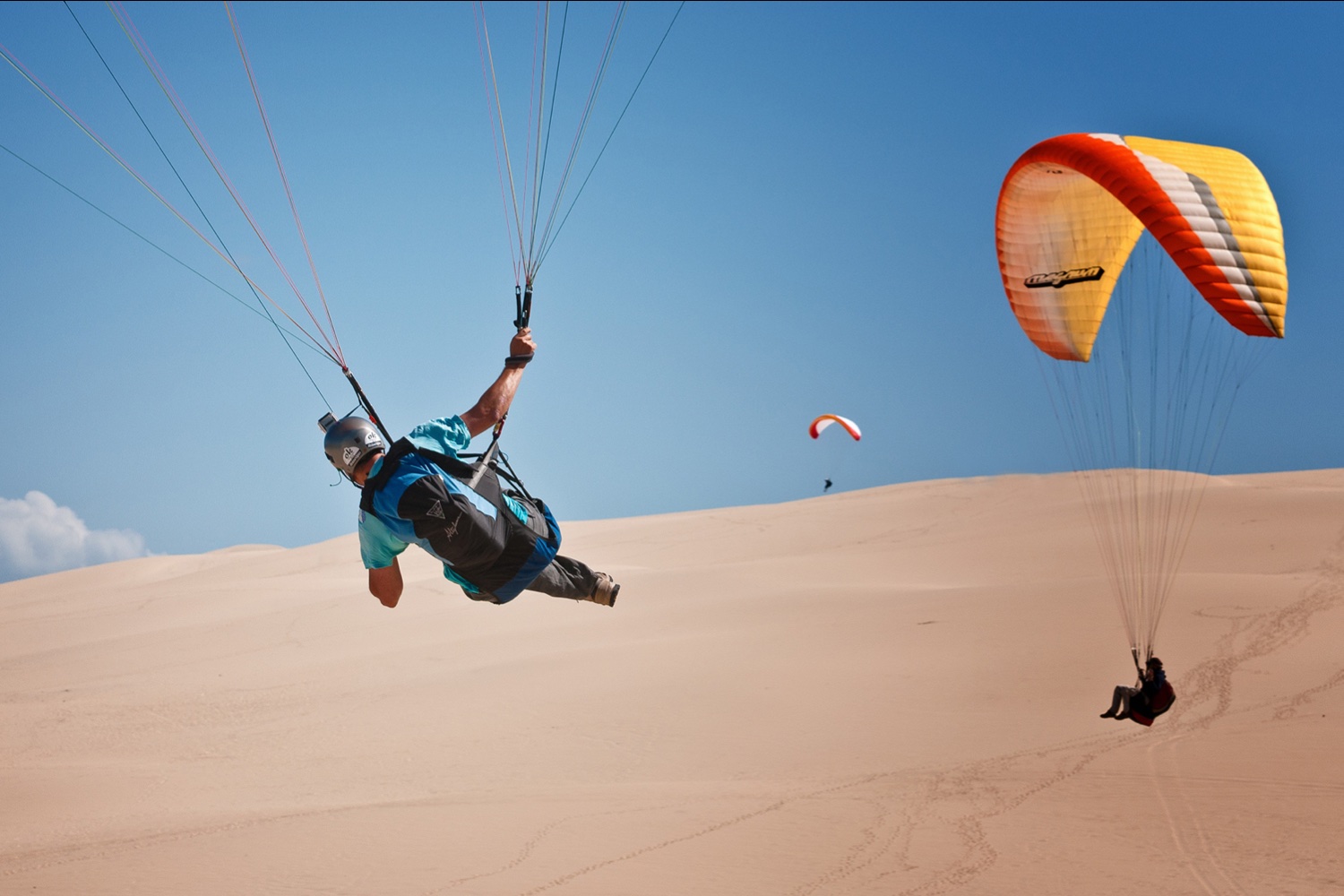
I regularly have requests for the rental of old paragliders to fly at the Dune du Pilat.
They are often pilots who are not used to strong wind, “touch and go”, raz-motte and “waggas”!
To avoid damaging their usual beautiful paraglider, they are ready to use an unknown old age and not maintained…
When the wind is strong, the consequences of a stall and a “negative” are tenfold!
A return to the slope is done at the speed of flight + wind speed, We can then hit the sand at more than 60 km/h!
To have fun in a soaring on a site of the type “dune du Pilat”, I strongly advise using a paraglider
- that you know well !
- recently controlled
This avoids stupidly increasing the risks!
Accelerated aging ?
Sand, sun, water and salt are scary.
Many pilots think that their paraglider will age by several years during a weekend at the Dune du Pilat.
This is not the case if the paraglider is not left wet (see my article the main enemy).
In more than 30 years of paragliding checks, I have never had to declare a glider unfit for flight because of the sand or, more generally, because of the abrasion of the fabric.
Anecdote
During an inspection, we even removed more than a kilo of sand from a light paraglider (NIVIUK KLIMBER) that the pilot thought was at the end of its life… And the canopy was still in very good condition (and much lighter!) at the end of our inspection!
Imagine the influence of this kilo accumulated in the trailing edge on the behavior of the paraglider…
Empty the sand regularly!
The danger: stall!
Common causes of near-ground stalls:
The wind speed decreases near the ground until it becomes zero in the last cm of altitude.
If you fly slowly close to the ground, a stall can occur when you arrive in a layer of air where the wind slows down enough that the paraglider’s airspeed is below that of the stall.
Reckless gestures caused by the stress of wanting to “target” are added to the wind gradient and turbulence.